Saturday, March 7, 2026

Dear Daily Disaster Diary, March 08 2026

 “Science likes to pretend it runs on curiosity and evidence. In reality, it often runs on something far older: whoever pays the bill.”

-adaptationguide.com


Follow the Money: Science Is Not Sacred — It’s Funded

It has never been conclusively proven what exactly motivated Jeffrey Epstein to pour millions of dollars into universities and prominent scientists. But let’s not insult our own intelligence.

When someone injects vast sums of cash into the machinery of academia, they are not buying lab equipment. They are buying proximity. They are buying credibility. They are buying influence.

And influence — not data — is the most dangerous currency in science.

Epstein had money. A lot of it. He distributed it through informal channels, cultivated elite circles of researchers, inserted himself into conversations, and reportedly entertained grotesque fantasies — including talk of a “baby ranch” to “improve” the human gene pool. That wasn’t philanthropy. That was access laundering.

Years later, as the so-called Epstein files continue to surface, the uncomfortable question is not just what he did — but what the scientific establishment allowed.

The Illusion of Clean Hands

In the United States especially, it is perfectly normal — expected, even — for researchers to accept external funding, including from private donors. Universities such as Harvard, Yale, and Stanford operate within a culture where philanthropy is baked into the system.

But let’s drop the fantasy:
You cannot pretend that research and teaching remain mentally independent when a wealthy patron stands behind you holding the checkbook.

Even if — and this is a massive if — administrators at Harvard, Yale, or Stanford truly did not know what was happening in the massage rooms on Epstein’s Caribbean island, Little Saint James.

Ignorance is not insulation.

If you take money, you assume responsibility. You must ensure your reputation and your research are not being weaponized for someone else’s agenda.

Today, several scientists publicly regret having accepted Epstein’s money. Cognitive scientist Joscha Bach told Die Zeit that, in hindsight, it was “morally fundamentally wrong” to accept support from Epstein, given the accusations that later became known.

But here’s the harder question:

What about before accusations become headlines?

The Core Problem Isn’t Donations. It’s Seduction.

The Epstein case does not prove that donations are inherently corrupt. It proves something more corrosive:

Universities and scientists too often interpret proximity to wealthy donors as opportunity — not as risk.

That is the rot.

Money from powerful private actors must be treated as a controlled substance:

  • strictly limited

  • rigorously vetted

  • radically transparent

Instead, academia often treats it as oxygen.

And no, relying on the “moral compass” of individual researchers is not enough. That is institutional negligence disguised as personal virtue.

Science Is Bleeding Trust — And It’s Not Just the Conspiracy Crowd

This is not only about individual researchers entangled with a criminal financier. The reputation of the entire scientific enterprise is at stake.

In the United States — and increasingly in Germany — science is under pressure. Social media has amplified “alternative facts,” conspiracy narratives, and anecdotal evidence masquerading as truth. Millions consume them daily.

Now imagine what happens when the public perception of science shifts from:

a principled pursuit of truth

to:

a corrupt elite network where powerful men exchange money, status, and influence behind closed doors.

Trust collapses.

And when trust in facts collapses, democracy weakens. Autocrats do not need to censor science if they can discredit it.

They are watching. And they are smiling.

Conflict of Interest Is Not a Footnote. It Is the Story.

If anyone should be audited relentlessly, it is not only politicians or corporations. It is science.

Follow the money.

Who funds the lab?
Who sponsors the chair?
Who finances the conference?
Who endows the institute?

What access do they gain in return?
What doors open?
What reputations are sanitized?

Conflict of interest in science is not a technicality buried in small print. It is often the central variable shaping outcomes, priorities, and public messaging.

And pretending otherwise is either naïve — or convenient.

Stop Worshipping Institutions

Science is not sacred. It is human. And wherever humans and money mix, power follows.

If you believe in free science as a pillar of democracy, then do not wait until court documents surface and files are unsealed. Do not issue regretful statements years later.

Open your eyes before the scandal.

Demand:

  • full donor transparency

  • public disclosure of all financial ties

  • independent oversight

  • strict conflict-of-interest enforcement

Because if science does not police its own entanglements with power, the public will assume the worst.

And once that trust is gone, it will not be restored by peer review.

It will be replaced by suspicion.

Follow the money.

Always.


yours truly,

Adaptation-Guide

Friday, March 6, 2026

Dear Daily Disaster Diary, March 07 2026

BLACKOUT IS NOT A CONSPIRACY. IT’S A POSSIBILITY.

The control room alarm goes off.

A high-voltage line fails.
Screens flash red.
Power flow unstable.

One minute later, it’s back.

“Probably a bird hit the line.”

Most outages begin that way. Small. Accidental. Fixable.

But here’s the uncomfortable truth no one wants to shout from the rooftops:

If someone really wants to turn your lights off — they probably can.

And if they bring enough money, coordination, patience, and criminal intent?

They can do far more than flicker a line.


⚠️ Europe Already Got a Preview

Berlin: Physical Sabotage

In January, tens of thousands of households and thousands of businesses in Berlin lost power for days.

Emergency shelters.
Food distribution.
Elderly evacuated.

The cause? Coordinated physical sabotage at a critical infrastructure node.

No missiles.
No Hollywood cyberwarfare.
Just cables cut in the right place.


Poland: Cyberattack That Almost Succeeded

4

Days before New Year’s Eve, a coordinated cyberattack nearly triggered a national outage.

This wasn’t ransomware amateurs.

This was long-prepared, professional, strategic.

Outside of active war zones, Europe had never seen something so complex against its grid.

And here’s the chilling part:

Industry insiders admit that in many countries, such an attack would have good chances of success.


Let’s Drop the Illusion: There Is No Absolute Protection

Energy infrastructure is not a fortress.

It is:

  • Visible

  • Mapped

  • Digitized

  • Interconnected

  • Partially privatized

  • Increasingly remote-controlled

It cannot be buried underground everywhere.
It cannot be guarded like a military bunker.
It cannot be sealed off from the internet completely — not anymore.

And in many regions, smaller municipal utilities still treat cybersecurity like a side hobby.

A survey not long ago showed companies giving themselves poor grades.

Cybersecurity was described internally as:

“A secondary task with low priority.”

That’s not conspiracy.
That’s bureaucracy.


The Structural Weakness Nobody Wants to Talk About

1️⃣ IT and OT Are Still Connected

Operational Technology (OT) — the systems that physically control electricity flow — are often directly linked to corporate IT networks.

Translation?

If you breach email or accounting systems, you may be one lateral move away from the grid.

And yes — ransomware gangs know this.


2️⃣ Oversight Is Often Soft

Regulators introduced minimum cybersecurity standards in many countries.

But enforcement?

Sometimes it’s just self-assessment surveys.

Audits? Rare.

Small providers? Overwhelmed.

Complex regulations without practical field guidance.

Security by paperwork.


3️⃣ Physical Infrastructure Is Exposed

4

Substations sit in open fields.
Transmission towers stretch across farmland.
Critical nodes can be identified by anyone with patience and Google Maps.

A determined group with insider knowledge doesn’t need a bomb the size of a car.

They need to hit the right node.

One well-chosen vulnerability can cascade.


4️⃣ Drones Changed the Game

Cheap drones.
Payload capacity.
Remote detonation.

Most utilities can detect them — maybe.

Few can legally intercept them.

Airports have advanced drone detection systems.

Many grid operators don’t.

Because until recently, this wasn’t considered a realistic threat.

It is now.


The Renewable Paradox: Clean Energy, New Attack Surface

Solar farms.
Wind parks.
Private rooftop systems.

Millions of decentralized installations.

Controlled via:

  • Cloud platforms

  • Remote firmware updates

  • Internet-connected inverters

In some regions, installed solar capacity already exceeds former nuclear output.

That’s progress.

But here’s the ugly flip side:

If attackers gained remote control over large fleets of inverters, they could rapidly toggle them on and off.

Second by second.

Frequency instability.

Voltage swings.

Grid collapse.

And yes — this scenario has been openly discussed by grid operators.

It is technically plausible.

Not easy.

But plausible.


“If Someone Has Enough Criminal Energy…”

One grid operator put it bluntly:

If a group brings enough criminal energy, they will find ways to shut down the grid.

That’s not panic.

That’s realism.


Why a Total Blackout Is Hard — But Not Impossible

To be fair:

  • Power grids are designed with redundancy (N-1 principle).

  • If one component fails, others compensate.

  • Recovery teams train constantly.

  • Spare parts are stockpiled.

  • Backup control centers exist.

  • Restoration protocols are fast.

The worst historic cyberattack on a grid (in Eastern Europe, 2015) saw power restored within hours.

Grids are resilient.

But resilience ≠ invulnerability.

And lower distribution levels are often less redundant.

If attackers target the right local bottleneck?

You get regional outages.

Days, not hours.

And modern society melts down fast.


Let’s Stop Pretending Blackout Preparedness Is “Prepping Culture”

It’s adaptation.

Hospitals rely on generators.
Water systems need electricity.
Payment systems collapse without power.
Telecom towers die.
Fuel pumps stop.
Heating systems fail.
Traffic lights go dark.

In three days, urban order becomes fragile.

In five, supply chains fracture.

In seven, trust erodes.

The question is not:

“Will it happen?”

The question is:

“How prepared are you when it does?”


ADAPTATION GUIDE: WHAT YOU CAN ACTUALLY DO

Welcome to the only practical response that matters.

🔦 1. Household Resilience (72 Hours Minimum)

  • 3–5 days water per person (4 liters/day)

  • Non-electric cooking method

  • Battery radio

  • Power banks (rotated)

  • Flashlights (no candles)

  • Physical cash

  • Printed emergency contacts

  • Backup medication

Not paranoia.

Baseline.


🔋 2. Energy Independence Lite

You don’t need a bunker.

But consider:

  • Small solar panel + battery station

  • Manual tools

  • Gravity-fed water filters

  • Insulated living space for winter outages

Decentralized resilience scales.


🧠 3. Digital Hygiene

  • Separate home Wi-Fi from IoT devices

  • Update firmware

  • Disable remote access where unnecessary

  • Use hardware-based MFA

  • Assume cloud systems can fail

Your rooftop solar inverter?
It’s a computer.

Treat it like one.


🏘 4. Community Networks

The real resilience multiplier isn’t gear.

It’s neighbors.

  • Who has medical skills?

  • Who has tools?

  • Who has storage?

  • Who checks on elderly residents?

Blackouts isolate.

Community reconnects.


🏢 5. Pressure Local Utilities

Ask:

  • Do you separate IT and OT networks?

  • Do you conduct real penetration tests?

  • Do you run physical intrusion drills?

  • Do you audit drone vulnerabilities?

  • Do you have manual override capability?

Security improves when citizens ask uncomfortable questions.


The Hard Truth

Modern grids are miracles of engineering.

They are also:

  • Digitized

  • Interconnected

  • Under constant probing

  • Politically exposed

  • Increasingly complex

No country is immune.

Not wealthy ones.
Not “neutral” ones.
Not technologically advanced ones.

And no government can promise absolute protection.


Final Reality Check

A blackout is not fantasy.

It’s not apocalyptic fiction.

It’s a systems failure waiting for the wrong combination of:

  • Neglect

  • Hubris

  • Underinvestment

  • Hostile actors

  • Digital dependency

The grid will not collapse tomorrow.

But the probability curve is not zero.

And pretending otherwise is intellectual laziness.


Adaptation is not fear.

It is responsibility.

Because when the screens go dark and the generators hum,

you will not care about political narratives.

You will care about water.

Warmth.

Information.

And whether you prepared.

Welcome to the era of infrastructure vulnerability.

This is not a drill.

⚡ Adapt accordingly.

yours truly,

Adaptation-Guide

Thursday, March 5, 2026

Dear Daily Disaster Diary, March 06 2026


Mediterranean Diet and Stroke Prevention in Women

A 21-Year Study Strengthens the Case for Food as Medicine

4

The Mediterranean diet has long been considered one of the most evidence-backed eating patterns in modern medicine. It is consistently associated with lower risks of cardiovascular disease, Type 2 diabetes, certain cancers, cognitive decline, depression—and now, new long-term data adds powerful evidence that it may significantly reduce both ischemic and hemorrhagic stroke risk in women.

A major 21-year study published in Neurology Open Access provides some of the strongest female-specific stroke prevention data to date.

Below is a fully evidence-based breakdown using the essential W framework.


WHAT Is the Mediterranean Diet?

The Mediterranean diet is a plant-forward dietary pattern rooted in traditional eating habits of countries bordering the Mediterranean Sea.

Core Components (Scored in the Study)

Participants received one point each for:

  • High vegetable intake (excluding potatoes)

  • High fruit intake

  • Whole cereal grains

  • Legumes (lentils, chickpeas, kidney beans)

  • Fish

  • Regular olive oil use

  • Low meat intake

  • Low dairy intake

  • Mild-to-moderate alcohol intake (≤30g/day)

Total score: 0–9

  • 0–2 = Low adherence

  • 6–9 = High adherence

This scoring system reflects decades of epidemiological research linking these foods to improved vascular health.


WHAT Is a Stroke?

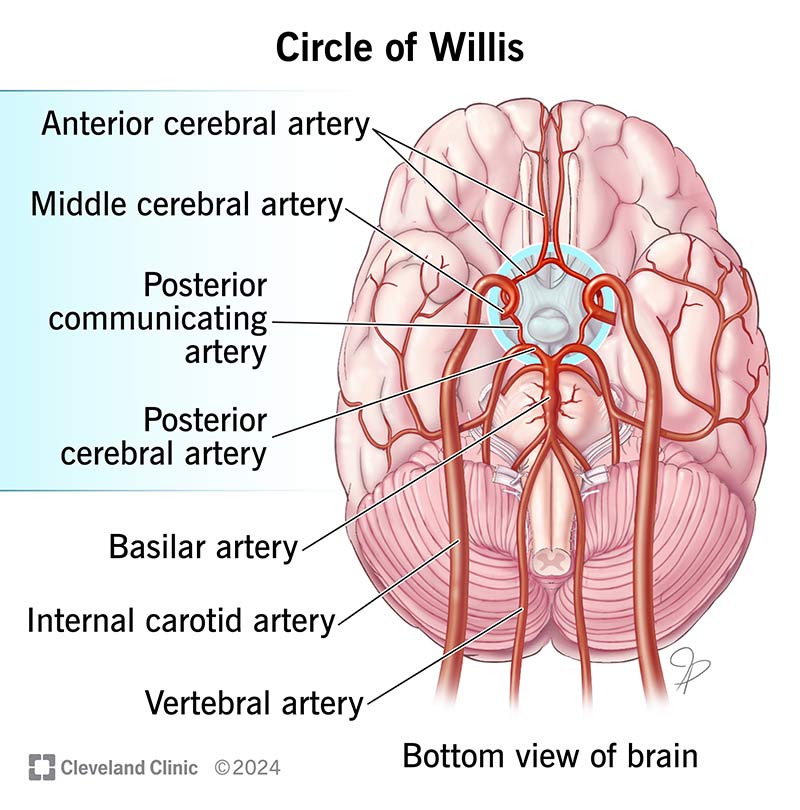
There are two major types:

1️⃣ Ischemic Stroke (≈85% of all strokes)

https://www.researchgate.net/publication/333439008/figure/fig1/AS%3A765616348749824%401559548570155/llustration-of-ischemic-stroke.jpghttps://my.clevelandclinic.org/-/scassets/images/org/health/articles/circle-of-willis
4

Cause: Blood flow to part of the brain is blocked by a clot or narrowed artery.

Major risk factors:

  • Age

  • Diabetes

  • High cholesterol

  • Obesity

  • Hypertension

  • Atrial fibrillation

  • Sleep apnea

  • Poor diet


2️⃣ Hemorrhagic Stroke

4

Cause: A blood vessel in the brain ruptures, causing bleeding and tissue damage.

Major risk factors:

  • High blood pressure

  • Smoking

  • Heavy alcohol use

  • High cholesterol

  • Obesity

Historically, diet has been strongly linked to ischemic stroke risk—but data on hemorrhagic stroke has been limited. This study helps fill that gap.


WHO Was Studied?

Researchers from the U.S. and Greece analyzed data from 105,614 women enrolled in the California Teachers Study.

  • Average age at baseline: 53

  • No prior stroke

  • Follow-up period: 21 years

  • Total strokes documented: 4,083

    • 3,358 ischemic

    • 725 hemorrhagic

This is one of the largest and longest female-specific dietary stroke studies ever conducted.


WHEN Was This Research Published?

The study was published February 4 in 2025 in Neurology Open Access, adding fresh longitudinal evidence to decades of Mediterranean diet research.


WHY Does the Mediterranean Diet Reduce Stroke Risk?

The protective mechanisms are biologically plausible and well-documented.

1️⃣ Blood Pressure Regulation

Olive oil, potassium-rich produce, and reduced processed foods improve endothelial function and reduce hypertension—the strongest stroke risk factor.

2️⃣ Anti-Inflammatory Effects

Chronic inflammation contributes to arterial damage and clot formation.
Mediterranean foods are rich in:

  • Polyphenols

  • Omega-3 fatty acids

  • Fiber

  • Antioxidants

These reduce inflammatory biomarkers like CRP.

3️⃣ Improved Lipid Profiles

Lower LDL cholesterol and higher HDL improve arterial health.

4️⃣ Better Insulin Sensitivity

Reduced diabetes risk = reduced vascular damage.

5️⃣ Improved Vascular Integrity

Emerging research suggests polyphenols and omega-3s may strengthen blood vessel walls—possibly explaining the reduced hemorrhagic stroke risk.


HOW Much Risk Reduction Was Observed?

After adjusting for:

  • Age

  • Race/ethnicity

  • Smoking

  • BMI

  • Physical activity

  • Calorie intake

  • Hypertension

  • Diabetes

  • High cholesterol

  • Atrial fibrillation

Women with high Mediterranean diet adherence had:

  • 18% lower overall stroke risk

  • 16% lower ischemic stroke risk

  • 25% lower hemorrhagic stroke risk

The hemorrhagic reduction is particularly striking because this subtype has historically been harder to modify through lifestyle.


WHY Is This Especially Important for Women?

Women face unique stroke dynamics:

  • Stroke risk increases sharply after menopause.

  • Women live longer, increasing lifetime exposure.

  • According to the Heart and Stroke Foundation of Canada:

    • 45% more women than men die from stroke.

    • More women live with long-term stroke disability.

Hormonal changes post-menopause affect:

  • Vascular stiffness

  • Lipid metabolism

  • Blood pressure regulation

Dietary intervention becomes even more critical in midlife and beyond.


STRENGTHS of the Study

  • Large sample size

  • 21-year follow-up

  • Detailed risk factor adjustment

  • Subtype-specific stroke analysis

  • First major study showing reduced hemorrhagic stroke risk in women


LIMITATIONS

  • Observational (cannot prove causation)

  • Self-reported dietary data

  • Diet assessed only at baseline

  • Participants were predominantly educators (may limit generalizability)

However, findings align with previous large trials such as the PREDIMED, which demonstrated cardiovascular risk reduction with Mediterranean diet intervention.


WHAT Should Women Actually Eat?

Evidence-based daily targets:

✔️ Vegetables at every meal
✔️ Fruit daily
✔️ Legumes 3–4x/week
✔️ Fish 2–3x/week
✔️ Extra-virgin olive oil as primary fat
✔️ Whole grains
✔️ Limited red meat
✔️ Minimal processed food

Alcohol, if consumed, should remain moderate (≤1 drink/day for women).


The Bottom Line

This 21-year study adds robust, subtype-specific evidence that strong adherence to the Mediterranean diet is associated with meaningful reductions in both ischemic and hemorrhagic stroke risk in women.

While it does not prove causation, the biological mechanisms, consistency across prior research, and long follow-up duration make the evidence compelling.

Stroke remains one of the leading causes of death and long-term disability in women. Unlike genetics or aging, diet is modifiable.

The Mediterranean diet is not a trend.
It is one of the most extensively studied, reproducible, and physiologically supported dietary patterns in preventive medicine.

Food is not just fuel.
It is vascular protection.


yours truly,

Adaptation-Guide


Wednesday, March 4, 2026

Dear Daily Disaster Diary, March 05 2026


World Cup 2026: Come for the Football, Stay for the Geopolitical Collapse

The 2026 FIFA World Cup is supposed to be a festival of football. Instead, it’s shaping up to be a three-country stress test in denial, denial, and maple-flavored denial.

The opening match is scheduled for June 11 at Estadio Azteca — a cathedral of the game. Pelé. Maradona. History. Glory.

And now? Armored vehicles and prayers.

Mexico: When “Security Presence” Means “Bring the Whole Army”

Holding mega-events in countries where cartels function as parallel governments has always required a certain level of optimism bordering on delusion. FIFA has mastered that art.

Recent violence linked to the Jalisco New Generation Cartel — after the reported killing of its leader Nemesio Oseguera Cervantes — was a reminder that in some regions, the state negotiates with reality rather than governs it.

Tourists were told to shelter in place. Flights were cancelled. Fires burned.

FIFA’s official position? “Monitoring the situation.”

Of course they are. FIFA monitors things the way a cat monitors a thunderstorm: by staring at it and hoping it goes away.

Mexican President Claudia Sheinbaum can promise stability. She can promise protection. She can promise a World Cup wrapped in steel and camouflage.

And she likely will deliver a security spectacle unmatched outside a military parade. Expect soldiers at airports. Soldiers at hotels. Soldiers at taco stands. The entire Mexican army distributed like confetti across host cities.

For two weeks, the cartels may decide to behave. After all, bad press is bad for business.

Then the circus packs up, and gravity resumes.

The United States: Land of the Free (Terms and Conditions Apply)

Co-host number two is the United States under Donald Trump — a man who treats international diplomacy the way most people treat expired milk: shake it, sniff it, blame someone else.

Travel bans. Visa paranoia. Border theatrics. Immigration raids by U.S. Immigration and Customs Enforcement that make international fans wonder whether their match ticket doubles as a liability waiver.

Iran qualifies? Good luck.
African nations qualify? Bring paperwork in triplicate.
Mexican fans crossing north? Hope your paperwork is laminated in gold.

And that’s before we talk about the political optics of holding a “global unity” tournament while half the globe is checking whether it’s still welcome.

It’s a strange vibe: “Welcome to the World Cup. Please remove your shoes, your dignity, and any expectation of warmth.”

FIFA: Morally Flexible Since 1904

If there were a gold medal for surviving scandal with a straight face, FIFA would retire undefeated.

Under President Gianni Infantino, the organization has elevated public groveling to a strategic art form. When former boss Sepp Blatter is suddenly sounding like the reasonable one in the room, you know the satire writes itself.

FIFA’s survival instinct is simple:

  • Smile.

  • Pose for photos.

  • Cash the check.

  • Repeat.

If geopolitics threatens the tournament? Flatter the strongman. Hug the headline. Invent a “peace” initiative. Hope the stadium Wi-Fi drowns out the sirens.

Canada: The Polite Fallout Shelter

Then there’s Canada.

Thirteen matches split between Toronto and Vancouver. Calm streets. Orderly queues. Universal healthcare in case your existential dread becomes clinical.

If things deteriorate further south, it’s not hard to imagine Canada quietly absorbing additional fixtures like the responsible sibling cleaning up after a house party gone nuclear.

“The safest place on the continent,” people will say — assuming the wildfire smoke isn’t drifting north and the jet stream isn’t carrying surprises from deregulated industrial zones below.

Bring sunscreen.
Bring a rain jacket.
Bring a mask — for smoke, for pollution, for irony.

What Will It Actually Look Like?

It will look like this:

  • Drones overhead.

  • Soldiers in the background of your Instagram story.

  • Visa hotlines crashing.

  • Politicians smiling too hard.

  • FIFA executives insisting this is “the most inclusive World Cup ever.”

It will also look like packed stadiums.
Roaring crowds.
Moments of transcendent football that briefly erase the absurdity.

That’s the uncomfortable truth.

The show will go on.

Because it always does.

But beneath the goals and the flags and the anthems, this tournament may feel less like a celebration of global unity and more like a live demonstration of how fractured that unity really is.

A World Cup co-hosted by:

  • A country fighting cartels.

  • A country fighting itself.

  • And a country quietly calculating evacuation routes.

If you’re reconsidering your tickets, you’re not irrational. You’re observant.

If you’re still going, you’re either brave, stubborn, or very committed to your loyalty points.

And if this entire spectacle somehow unfolds without incident?

It will be hailed as a triumph.

Not of football.

But of denial.

Welcome to World Cup 2026.

Hope your passport is valid.
Hope your travel insurance covers geopolitics.
And if all else fails — at least the football might be beautiful.


yours truly,

Adaptation-Guide

Dear Daily Disaster Diary, March 13 2026

  PART 2 The Dangerous Comfort of Decline Decline rarely feels dramatic when you’re living through it. Ask a Roman in the fourth century w...